
There’s a moment in nearly every health tech GTM conversation where things quietly go sideways.
The founder explains the product to me. I get it. The technology is real, the use case is sharp, the outcomes are credible. Then I ask a simple question: who buys this, and who actually uses it? And the answer is some version of, “Well, we sell to health plans, who sell it to employers, but it has to pass through brokers for approval oftentimes for an employer to deploy it to members.”
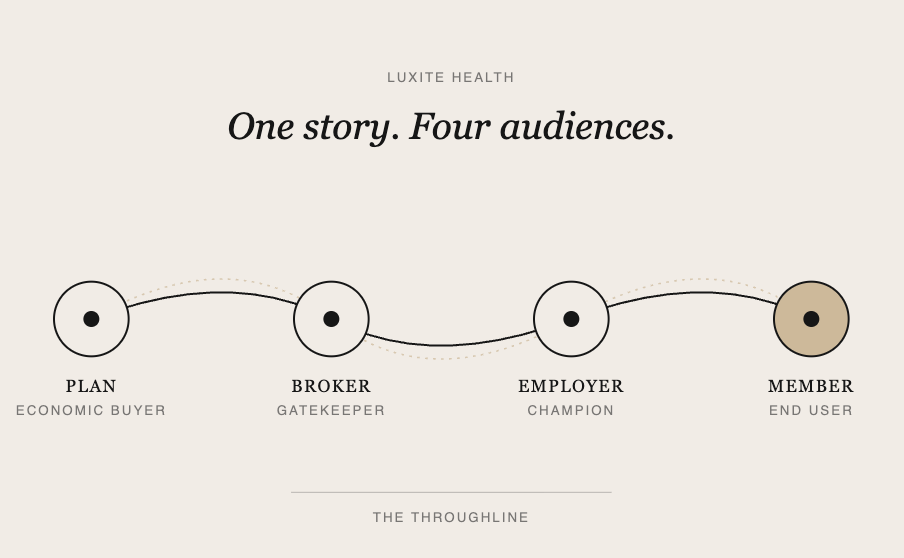
That’s not a sales motion. That’s a four-audience problem. And it’s the silent killer of health tech GTM.
The B2B2B2C reality no one prepared you for
Most go-to-market playbooks were written for B2B or B2C. Health tech is neither. In our world, a single product often has to land with:
– A health plan or employer as the economic buyer
– A broker or consultant as the gatekeeper and influencer
– An HR or benefits leader as the client-side champion
– A member, patient, or employee as the actual end user
Four audiences. Four sets of incentives. Four definitions of value. And in many cases, four completely different vocabularies for the same product.
The instinct most founders have, and I understand why, is to build a different message for each one. Different decks, different one-pagers, different website pages, different email sequences. By month six, you have a fragmented narrative held together by font choices and hope.
The product is the same. The story should be too.
Why a single value proposition is non-negotiable
I work with a lot of early- and growth-stage health tech companies, and the pattern I see most often isn’t a bad product. It’s a product whose story changes shape depending on who’s telling it.
The CEO pitches one version on stage. Sales tells a different version to brokers. The website tells a third version to employers. The app store listing tells a fourth to members. Internally, no one notices because everyone is fluent in all four. Externally, the market hears four companies.
A value proposition is not a tagline. It’s the load-bearing wall of your GTM. It answers a single question: what is fundamentally true about this product, regardless of who is buying or using it?
When that wall is solid, every audience-specific message becomes a translation, not a rewrite. When it’s missing, every channel becomes its own improvisation, and improvisation does not scale.
The throughline test
Here’s the test I run with founders. Take your value proposition and ask whether it can pass through every layer of the distribution chain without losing its meaning.
If your core promise is “we reduce avoidable healthcare spend through earlier intervention,” it should hold up whether you’re talking to:
– A health plan evaluating medical loss ratio impact
– A broker trying to differentiate their book of business
– An HR leader managing benefits cost and employee experience
– An employee trying to figure out where to go when their kid spikes a fever at 9 PM
Same promise. Different proof points. Different language. Same throughline.
If your value prop only resonates at one or two of those layers, you don’t have a value prop yet. You have a feature pitch.
Where the message usually breaks
In practice, I see the throughline break in three predictable places:
1. The middle of the chain gets ignored.
Most founders over-invest in the economic buyer and the end user, and under-invest in the broker, consultant, or benefits advisor sitting between them. That middle layer is often where the deal is actually won or lost. They’re not just intermediaries, they’re the people whose recommendations carry weight in renewal conversations and RFPs. If your messaging doesn’t give them a clean way to position you to their clients, you are quietly being left out of shortlists you’ll never see.
2. The end user becomes an afterthought.
The opposite failure mode: the product is sold beautifully to the buyer, deployed competently, and then engagement craters. The buyer churns at year two. This happens when the consumer-facing message — the one that lives in the app, the welcome email, the text message — was never designed with the same rigor as the buyer pitch. Engagement is a GTM problem, not just a product problem.
3. The story shifts depending on who’s in the room.
This one is the most insidious because it feels like sophistication. We tailor our message to each audience. Tailoring is good. Reinvention is not. When the underlying narrative drifts, brokers tell employers something different from what the website says, employers tell employees something different from what the broker said, and the member experience feels disconnected from the promise that brought them in.
What a strong throughline looks like
A defensible value proposition in B2B2B2C health tech does three things at once:
– It names a specific, expensive problem the buyer is actively trying to solve.
– It explains how the product solves it in language the gatekeeper can repeat without paraphrasing.
– It connects to a member experience that feels like a continuation of the buyer’s promise, not a separate product.
That last point is where a lot of companies fall short. The member opens the app or gets the text and the experience feels nothing like what was sold upstream. When that happens, you don’t just lose engagement. You lose the buyer’s trust in the next renewal cycle, because they can’t reconcile what they bought with what their people experienced.
The discipline this requires
Building a throughline is not a copywriting exercise. It’s a strategic exercise that touches positioning, sales enablement, website architecture, sales collateral, in-product messaging, and customer success. It requires saying the same thing in four registers without losing the spine of what you actually do.
This is hard for founders to do alone. Not because they aren’t capable, most are exceptionally capable, but because they’re too close to the product. Founders see every nuance. Markets see one sentence. The work of GTM is collapsing the nuance into the sentence without losing what matters.
In my experience, the companies that get this right tend to share three traits: they invest in positioning before they invest in volume, they audit their messaging across every channel at least quarterly, and they treat their distribution partners as a third audience to be enabled, not a pipe to be pushed through.
The bottom line
If you’re selling into the B2B2B2C space and your message changes shape every time it changes hands, you don’t have a distribution problem. You have a positioning problem. And no amount of pipeline, paid media, or partnership activity will fix it until the story holds.
Get the throughline right, and every channel starts compounding. Get it wrong, and every channel starts leaking.
The product is the same. Make sure the story is too.