Every founder, operator, and GTM strategist eventually runs into the same deceptively simple question: what comes first, the product or the market demand?
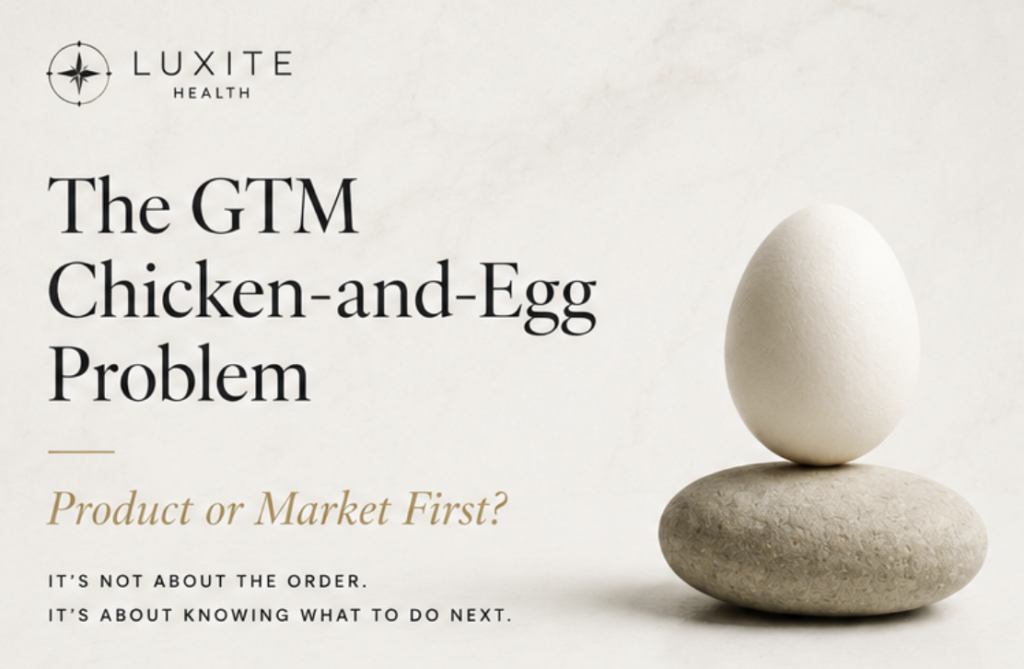
It is the classic chicken-and-egg problem of go-to-market strategy. Do you build something because you know the market needs it, or do you create something so compelling that the market forms around it?
The honest answer is less satisfying, but far more useful: it depends. More importantly, it evolves.
Two Paths to Product-Market Fit
In practice, most successful companies tend to follow one of two paths.
The first is demand-led. You identify a clear, validated pain point, often through lived experience, customer discovery, or market data, and build directly against it. This approach is common in healthcare, where inefficiencies, regulatory gaps, and underserved populations create obvious opportunities. Think incremental innovation: better workflows, improved access, reduced costs.
The advantage here is clarity. You are solving a known problem for a defined audience. The risk, however, is building something that is only marginally better in a crowded space.
The second path is product-led. Here, the product itself is the breakthrough. It introduces a new behavior, a new model, or a new category altogether. In this case, the market may not yet exist in a fully formed way. You are effectively educating users while proving value in real time.
This is where category-defining companies emerge. But it comes with a different risk. You may be right about the future, but too early for the present.
Why the Question Itself Is Misleading
The mistake is treating this as a binary decision.
In reality, product and market are in constant dialogue. The best founders are not rigidly committed to one or the other. They are continuously calibrating between the two.
A product built for a clear demand will still need to evolve as real-world usage reveals new constraints. A visionary product will still need to find its most receptive initial market, even if it eventually expands.
Especially in healthcare, where adoption cycles are long and stakeholder incentives are complex, this interplay becomes even more critical. You are not just building for users. You are navigating buyers, regulators, providers, and patients simultaneously.
What Actually Matters: Adaptability Over Order
If there is a right answer, it is this: the sequence matters far less than your ability to adapt.
Strong teams treat early assumptions as hypotheses, not truths. They listen aggressively, iterate quickly, and remain willing to reshape both the product and the target market as signals emerge.
- If demand exists but adoption lags, the product likely needs refinement.
- If the product is strong but traction is limited, the market segment or positioning may be off.
- If both seem misaligned, it may be a signal to revisit the core value proposition altogether.
The companies that succeed are not the ones that guessed correctly at the start. They are the ones that adjusted intelligently along the way.
The Role of Patience in Healthcare GTM
This dynamic is amplified in healthcare.
Unlike consumer tech, where market signals can emerge in weeks, healthcare GTM cycles often take months or years. Pilots, procurement processes, clinical validation, and regulatory considerations all slow down feedback loops.
This creates a dangerous tension. There is pressure to move fast in an environment that inherently moves slowly.
Patience, in this context, is not passivity. It is disciplined iteration over longer timelines. It is resisting the urge to overcorrect too quickly while still remaining responsive to real signals.
Final Thought
The product versus market debate makes for a compelling narrative, but it misses the deeper point.
Great companies are not built by choosing the right starting point. They are built by staying flexible enough to meet the market where it is and where it is going.
In the end, it is not about whether the chicken or the egg comes first.
It is about whether you are paying close enough attention to know which one you need next.